
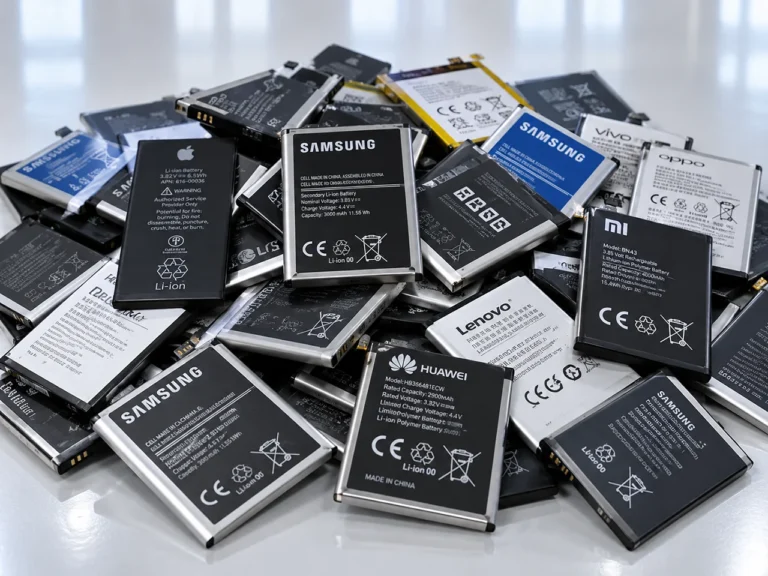
Pouch Lithium-Ion Batteries
Flexible pouch cells and similar 3C battery formats suitable for roller needle-puncture discharge.
A controlled discharge system for charged lithium-ion batteries that releases stored electrical energy through needle puncture, roll cutting or stamping-based short-circuit methods before downstream dismantling or recycling. The line can be configured for pouch, hard-shell, cylindrical and larger lithium-ion batteries, with adjustable discharge mechanisms, spray cooling, conveying and downstream environmental treatment. Final discharge method is selected according to battery format, dimensions, state of charge, casing structure and downstream recycling process.
Discharge pretreatment — not pack/module dismantling and not cell crushing or black-mass recovery.
Charged lithium-ion batteries can retain significant electrical energy before recycling. BREM configures the discharge line to reduce residual energy through a controlled mechanical short-circuit method before batteries enter downstream dismantling or crushing processes.
According to the supplied technical material, the discharge system uses needle puncture, roll cutting or stamping puncture to penetrate or open the battery structure and create an internal short circuit between positive and negative electrodes. This allows stored energy to be released quickly under controlled operating conditions.
Different battery formats require different discharge mechanisms. Pouch and plastic hard-shell batteries can use a roller needle-puncture process, cylindrical cells can use a roll-cutting configuration, and larger lithium-ion batteries can use a stamping needle-puncture mechanism.
After discharge, batteries can enter a mesh-belt circulation section with spray cooling. The lower section includes a water tank and circulation pump, allowing cooling water to be reused within the process.
01 — Multiple Discharge Methods: Roller puncture, roll cutting and stamping puncture configurations can be selected according to battery structure and size.
02 — Rapid Energy Release: The source process uses controlled short-circuit discharge to release stored battery energy before downstream recycling.
03 — Adjustable Battery Handling: Roller gaps and discharge mechanisms can be adjusted or configured for different lithium-ion battery formats.
04 — Integrated Cooling: A spray-cooled circulation conveyor helps reduce temperature after discharge and stabilize material before the next processing stage.
This page describes charged lithium-ion battery discharge before dismantling / crushing / recycling. It is not an EV pack dismantling line, module dismantling line, cell crushing line, black-mass recovery line or electrode-sheet recycling line. Unsupported absolute discharge or fire-risk marketing claims from legacy copy are not used.
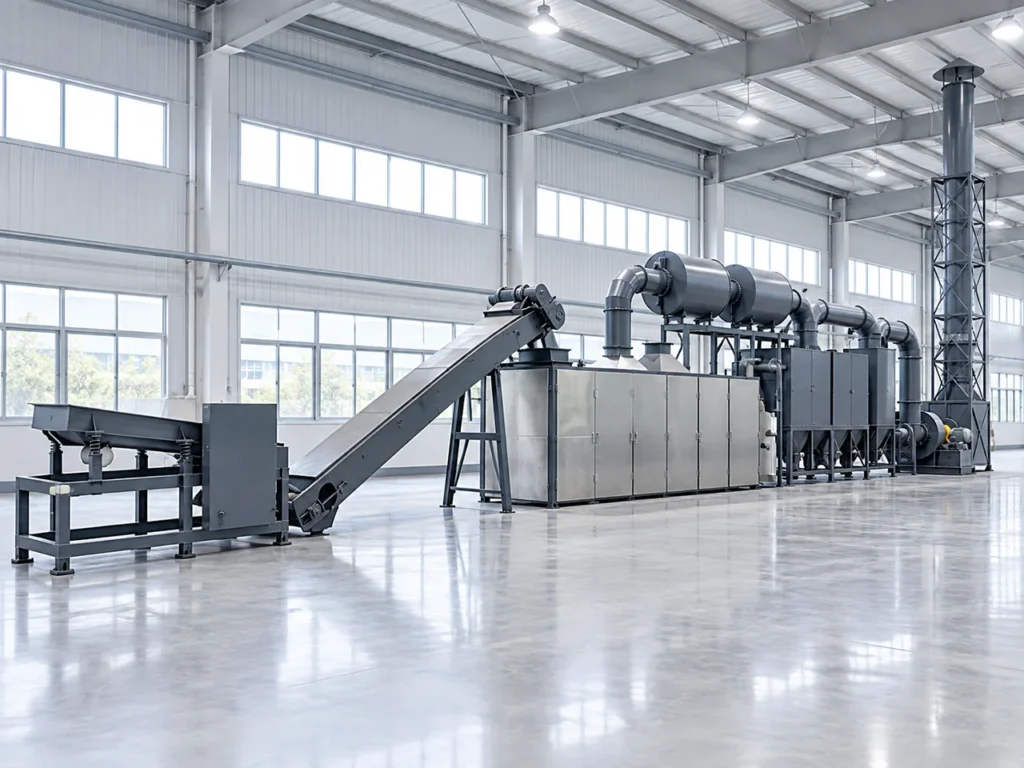
The standard feed is charged lithium-ion battery material that requires controlled discharge before dismantling or recycling. The appropriate discharge mechanism depends on battery format and casing structure.
Flexible pouch cells and similar 3C battery formats suitable for roller needle-puncture discharge.
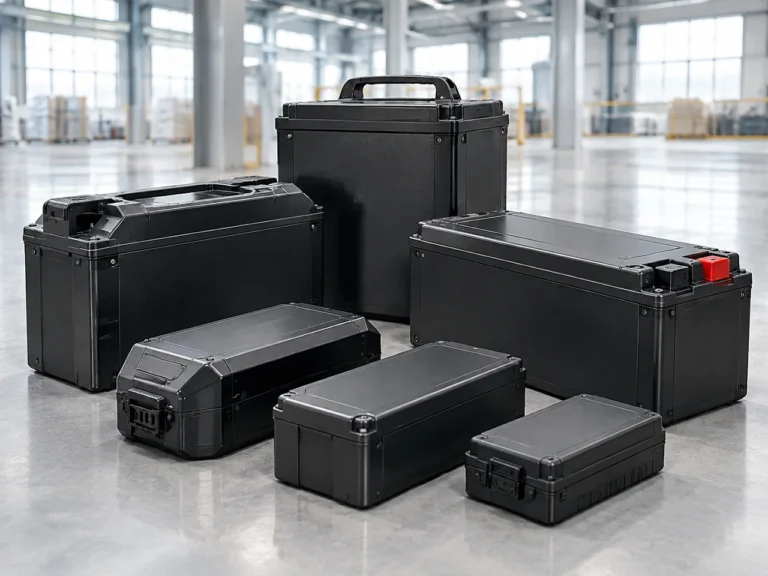
Rigid plastic-housing lithium-ion batteries that can be processed using an adjustable roller needle-puncture configuration.
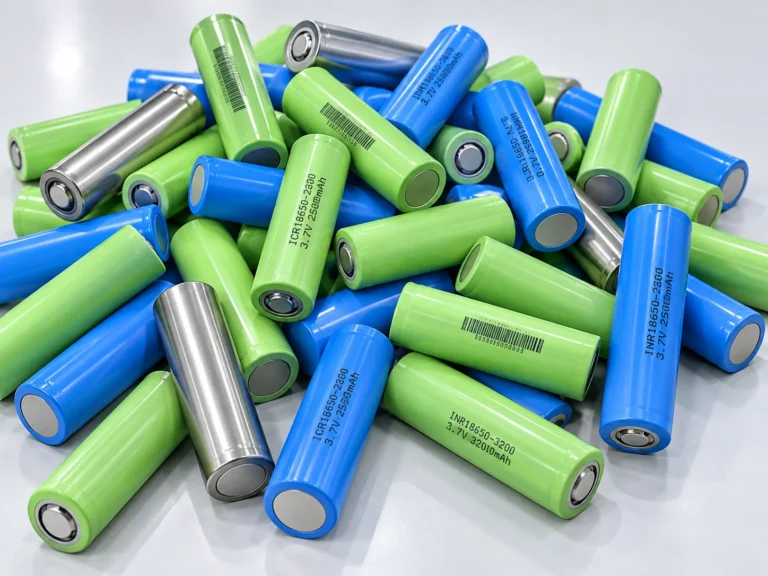
Cylindrical cells suitable for roll-cutting discharge, where the casing is mechanically cut to create controlled internal short-circuit discharge.
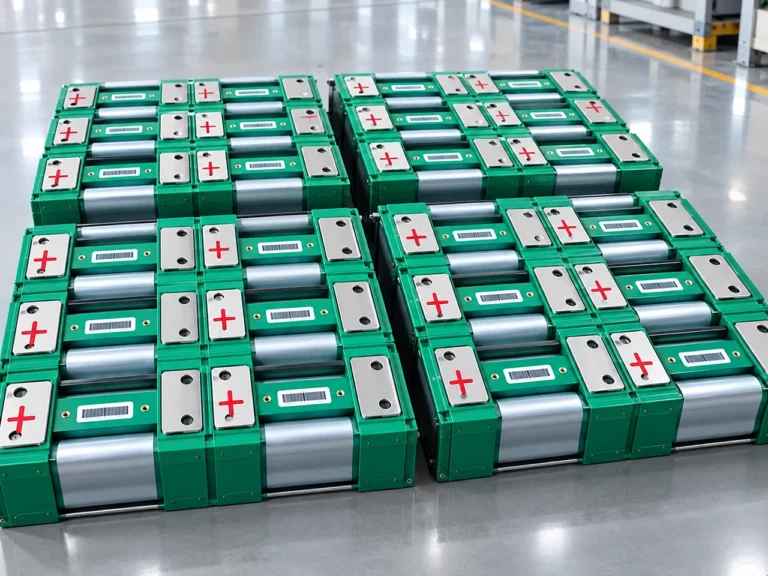
Larger battery formats requiring clamping and stamping needle-puncture discharge.
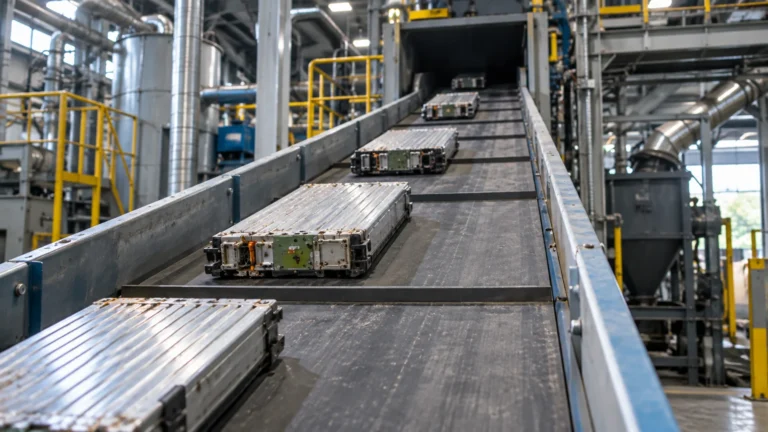
Battery material after controlled energy release, prepared for downstream dismantling, crushing or recycling.
Discharged batteries after spray cooling and circulation conveying, stabilized before entering the next process.
Heat, vapor or process gas generated during discharge is directed to the configured downstream environmental-treatment system.
Cooling water collected in the lower tank and recirculated through the spray system according to the source configuration.
Battery chemistry, state of charge, visible damage, leakage, swelling, temperature and casing condition should be checked before entering the standard discharge process. Severely damaged or thermally unstable batteries require a dedicated safety procedure.
The supplied system uses different discharge mechanisms for different lithium-ion battery formats, followed by spray cooling and controlled material transfer.
Format-matched puncture or cutting creates a controlled short-circuit path; spray cooling and recirculation stabilize material before transfer to dismantling or crushing.
Incoming batteries are checked and classified by shape, size, casing type, visible condition and discharge-method suitability before processing.
Charged batteries are delivered to the discharge mechanism through a feeder or conveyor at a controlled rate.
The battery is aligned between rollers, positioned in the roll-cutting section or fixed in a stamping slot depending on the selected discharge method.
The battery casing is punctured or cut so the internal positive and negative electrode structures form a controlled short-circuit path and release stored electrical energy.
Residual battery energy is dissipated through the controlled short-circuit process before the material moves to downstream handling.
The discharge stage is monitored through the configured control system and protection logic. Final monitoring points should follow the current engineering design.
Discharged batteries are transferred from the discharge mechanism to the circulation conveyor.
A spray system cools the discharged battery material during conveying.
Water is collected in the lower tank and returned through a circulation pump for reuse in the cooling loop according to the source configuration.
Cooled discharged material is transferred to downstream dismantling, crushing or recycling equipment according to the customer's complete process route.
The discharge method must be matched to battery format. Do not show one single mechanism as universally suitable for all lithium-ion batteries. Rear environmental treatment is configured by project after reviewing actual emissions.
The complete line can include different mechanical discharge modules according to battery type. Discharge units are described as line components because no matching standalone Product CPT currently exists; rear environmental Products are selected only when confirmed for the project.
Equipment cards will appear here once published Products are linked.
Four source discharge variants (line components — not auto-created Product CPTs):
1) Roller Needle-Puncture Discharge — charged batteries pass between a needle roller and grooved roller; steel pins puncture the battery and create an internal short circuit. Primarily pouch / plastic hard-shell / similar 3C formats. Roller gap adjustable.
2) Roll-Cutting Discharge — batteries feed between a grooved roller and a cutting roller; blades cut the casing to create a short-circuit path. Primarily cylindrical cells. Roller spacing adjustable.
3) Stamping Needle-Puncture Discharge — battery fixed in a stamping slot and punctured by steel pins on an upper stamping block. Larger lithium-ion formats; sensing/positioning may accommodate different types.
4) Discharge Circulation Box — mesh-belt transfer with spray cooling; supporting water tank and circulation pump.
Also: control cabinet / discharge control system; hot-air exhaust / rear environmental-treatment train (project may select from existing catalog Products such as water-spray scrubber, activated-carbon adsorption, oil-fume purification, pulse-jet baghouse or plasma purification after engineering confirmation — not auto-linked here).
The supplied technical material provides reference installation, environmental and power requirements. Values below are source reference data and must be confirmed for the final project layout.
| Parameter | Specification |
|---|---|
| Processing Capacity | Configured by project — no verified universal throughput or discharge time in the supplied source |
| Applicable Feedstock | Charged lithium-ion batteries (pouch, hard-shell, cylindrical, larger formats — method-matched) |
| Applicable Battery Chemistry | Lithium-ion chemistries as reviewed for the project — confirm before operation |
| Processing Method | Roller needle puncture / roll cutting / stamping needle puncture + spray cooling circulation |
| Recovered Fractions | Discharged / cooled batteries prepared for dismantling or crushing (not a final recycled product stream) |
| Automation Level | Coordinated electrical control / discharge control cabinet |
| Installed Power | Source reference: approx. 15 kW — confirm for final configuration |
| Typical Floor Space | Source reference envelope: 12000 × 4000 × 2300 mm (L × W × H); layout adjustable to site |
| Operating Mode | Continuous / semi-continuous discharge with spray-cooled mesh-belt circulation |
| Dust Control | Source capture / exhaust handling around the discharge area as configured |
| Exhaust Treatment | Project-specific rear environmental treatment according to emissions and local requirements |
| Utilities | AC380V / AC220V; voltage fluctuation <10%; grounding required; compressed air not required; vacuum not required; ambient -15°C to 42°C; RH 20%–80%; ground load reference 500 kg/m² |
REFERENCE SITE / UTILITY DATA FROM SUPPLIED MATERIAL:
• Equipment layout / site envelope: 12000 × 4000 × 2300 mm (L × W × H)
• Ambient temperature: -15°C to 42°C
• Relative humidity: 20%–80% RH
• Ground load requirement: 500 kg/m²
• Total power: approx. 15 kW
• Main power supply: AC380V / AC220V
• Voltage fluctuation: <10%
• Grounding: workshop equipment grounding required
• Compressed air: not required
• Vacuum: not required
• Layout flexibility: equipment layout can be adjusted to actual site conditions
Do not invent processing capacity, discharge cycle time or final residual voltage. Quantified residual-voltage or completion criteria may be added only after current engineering verification. Unsupported absolute discharge or fire-risk marketing claims from legacy copy are not used on this page.
The purpose of the discharge line is to reduce residual battery energy and deliver more stable material to downstream dismantling or recycling processes.
Lithium-ion battery material after controlled energy release through the selected puncture or cutting process.
Discharged battery material after spray cooling and circulation conveying, prepared for the next handling or recycling stage.
Battery material transferred from the discharge line to the downstream dismantling or crushing/recycling process.
The supplied material does not provide a verified residual-voltage specification or universal discharge-completion criterion. A quantified target is added only after engineering verification.
This equipment intentionally creates a controlled electrical short circuit in charged lithium-ion batteries. The complete line therefore requires strict mechanical, electrical, thermal and fire-safety controls.
Check battery shape, visible damage, leakage, swelling, temperature and suitability for the selected discharge method before feeding.
Feed batteries at a controlled rate and maintain stable positioning through the puncture, roll-cutting or stamping stage.
Critical discharge and cooling points should be monitored for abnormal heat rise according to the current engineering design.
The discharge mechanism should be mechanically enclosed and guarded to isolate puncture/cutting components and contain abnormal material movement.
Spray cooling and the circulation section help control post-discharge temperature. Additional fire-protection measures should be selected according to battery chemistry and project risk assessment.
Feeding, discharge, cooling and exhaust systems should be interlocked so abnormal conditions stop the process safely.
Thermally unstable, leaking or severely damaged batteries should not automatically enter the standard process. They require a dedicated abnormal-battery handling procedure.
The source states that energy released during discharge is handled together with a rear environmental-treatment system. Final environmental controls should be selected according to battery chemistry, discharge method and actual gas / particulate generation.
Spray cooling reduces battery temperature during post-discharge conveying.
The lower tank and circulation pump support reuse of spray water within the cooling system.
Heat, vapor or process gas generated around the discharge area should be captured through the configured exhaust system.
Downstream purification equipment should be selected according to actual process emissions and local environmental requirements.
Unsupported absolute emission claims are not used on this page. Exhaust compliance is project-specific and must follow applicable local requirements after engineering confirmation.
Reference Configuration / Process Equipment Material — not a named customer case.
The reference process selects different discharge mechanisms according to battery geometry. Roller needle puncture is used for pouch and hard-shell batteries, roll-cutting discharge is used for cylindrical cells, and stamping puncture is used for larger battery formats. After controlled discharge, battery material enters a mesh-belt circulation section where spray cooling reduces temperature before transfer to downstream dismantling or crushing. The supplied site reference lists an approximate 12,000 × 4,000 × 2,300 mm equipment envelope, approximately 15 kW total power, AC380V / AC220V supply and no compressed-air or vacuum requirement. Capacity, discharge time and residual voltage are not invented for this reference layout.
No customer name, country, commissioning year, throughput, discharge time or residual-voltage guarantee is invented.
Resolve format matching, cooling and pretreatment-scope questions before requesting a proposal.
The line reduces residual electrical energy in charged lithium-ion batteries before downstream dismantling or crushing. It uses a controlled puncture or cutting method to create an internal short-circuit path and release stored energy.
The supplied source describes configurations for pouch batteries, plastic hard-shell batteries, cylindrical lithium-ion cells and larger-format batteries. The correct discharge method should be selected according to battery geometry and casing structure.
Roller puncture uses steel pins mounted on a rotating needle roller; roll cutting uses blades to cut the casing of cylindrical batteries; stamping puncture fixes the battery and uses steel pins on a stamping block to puncture larger-format batteries.
Yes. The supplied source states that the gap between the roller pairs can be adjusted to accommodate different lithium-ion battery dimensions.
Discharged batteries are conveyed through a circulation section with spray cooling. The lower section includes a water tank and circulation pump for cooling-water reuse.
No. This is a pretreatment discharge system. After discharge and cooling, the batteries still need to enter the appropriate dismantling, crushing or material-recovery process.
The supplied reference lists approximately 15 kW total power, AC380V / AC220V supply, ambient temperature from -15°C to 42°C, relative humidity of 20%–80% RH and a reference ground load of 500 kg/m². Final layout and utilities should be confirmed for the project.
Please provide battery type, chemistry if known, shape, dimensions, casing material, state of charge, visible condition, hourly or daily capacity target, downstream recycling process, project location, available floor space and electrical standard.
Provide BREM with battery format, dimensions, casing type, state of charge and your downstream recycling route. Our engineering team will recommend the discharge mechanism, cooling circulation and environmental-treatment configuration for your project.
You can also upload material photos, equipment images, plant layouts or technical documents.
You don't need to know all the technical details. Tell us what you're working with and what you want to achieve, and our team will help you determine the next step.