
01
Contaminated Air Inlet
Contaminated process air enters the purifier through the inlet side and is guided into the internal treatment section.
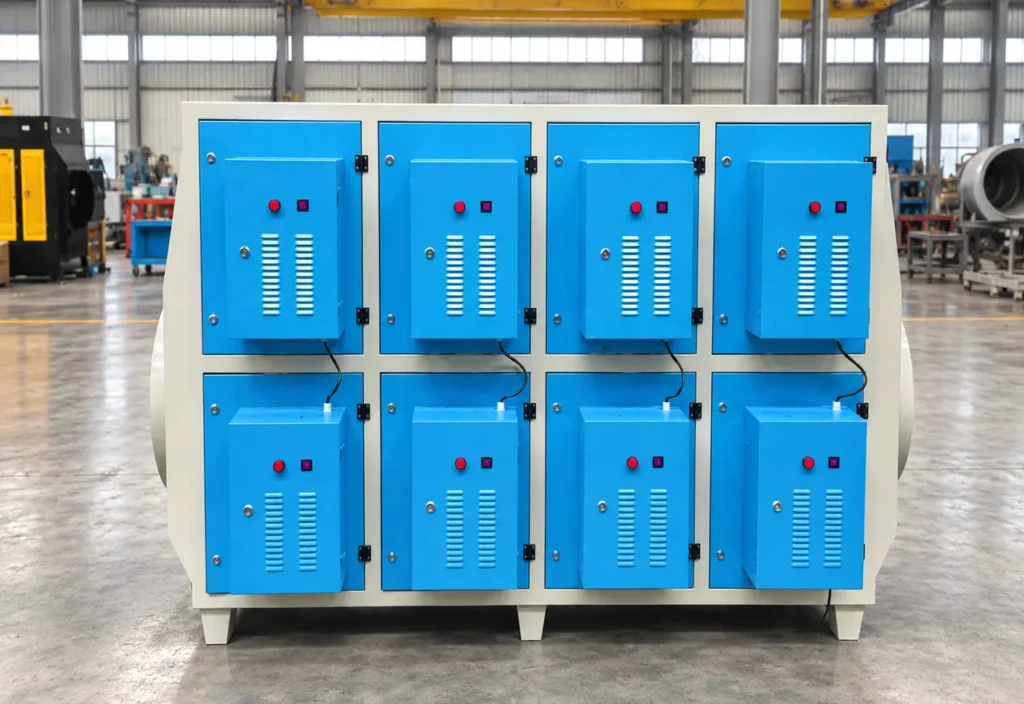
Plasma Exhaust Purification Equipment is an industrial gas-treatment system designed to treat selected gaseous pollutants and odor compounds through low-temperature plasma reactions. Inside the treatment zone, a high-voltage electric field generates energetic electrons and reactive species. These active species interact with contaminant molecules and may promote ionization, excitation, dissociation, oxidation and other physical or chemical reactions.
A low-temperature gas-phase treatment stage after pretreatment and, when required, before adsorption or other polishing.
Plasma Exhaust Purification Equipment is an industrial gas-treatment system designed to treat selected gaseous pollutants and odor compounds through low-temperature plasma reactions. Inside the treatment zone, a high-voltage electric field generates energetic electrons and reactive species. These active species interact with contaminant molecules and may promote ionization, excitation, dissociation, oxidation and other physical or chemical reactions. The purpose of the system is to transform selected complex pollutant molecules into simpler compounds or reduce odor and contaminant loading before final discharge or downstream polishing. The final configuration must be selected according to gas composition, concentration, airflow, temperature, humidity, flammability and local emission requirements. This equipment is distinct from an activated-carbon adsorption system: plasma uses electrical reactions to transform selected gas-phase contaminants, while activated carbon retains compatible molecules on a porous adsorbent. It is also distinct from an oil-fume purifier, which primarily captures liquid droplets and aerosol particles through filtration and electrostatic collection.
The collected source does not provide reliable model-specific values for airflow, high-voltage settings, residence time, ozone control or removal efficiency.
02 / Operating Principle
Contaminated exhaust enters the purification cabinet through the inlet section and passes through a sequence of internal plasma treatment modules. Inside the reactor zone, high-energy plasma acts on odor molecules, VOCs and other gaseous pollutants, breaking down complex compounds and promoting further oxidation. The treated air then moves into the outlet chamber and is discharged for downstream exhaust or release.
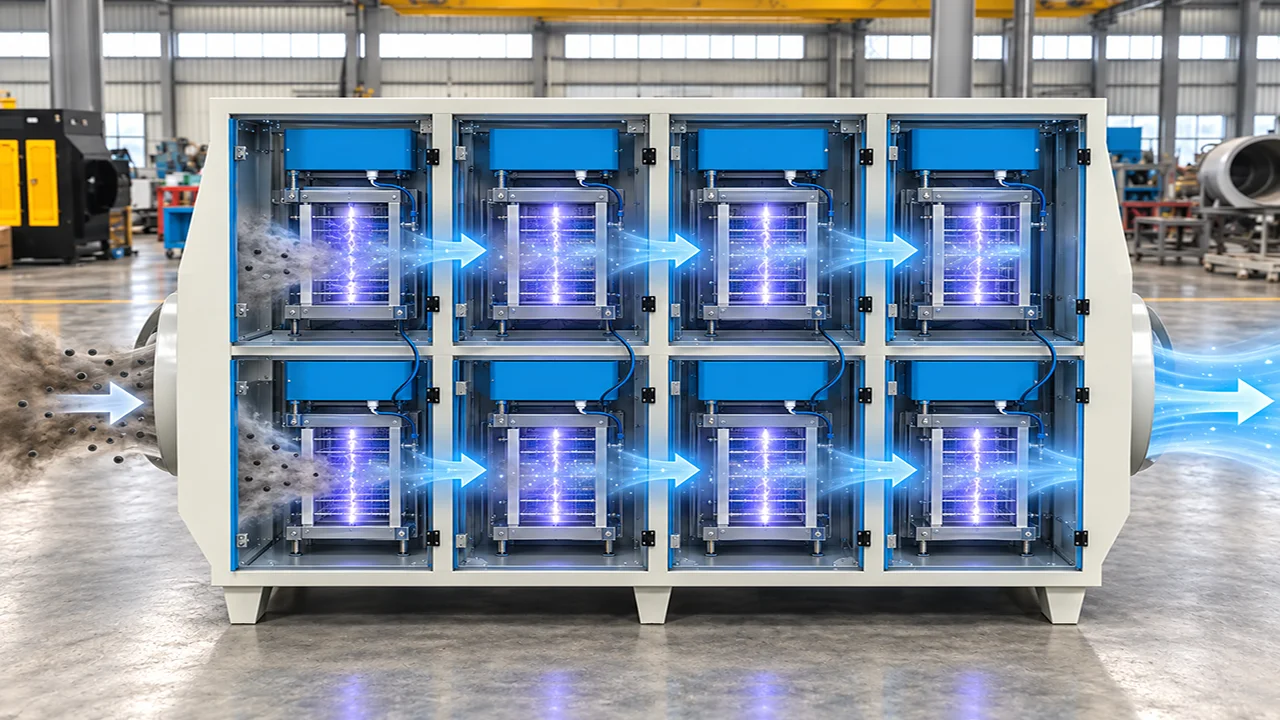
Contaminated process air enters the purifier through the inlet side and is guided into the internal treatment section.
The incoming airflow is distributed evenly across the multi-module purification chamber to ensure stable treatment.
The gas stream passes through the plasma reactor modules, where high-energy plasma decomposes pollutants and promotes purification of the exhaust stream.
After treatment, the purified air is collected in the outlet section and discharged through the outlet duct.
Selected low- to medium-concentration odor streams, subject to gas analysis and safety review.
Compatible organic contaminants after review of concentration, humidity, flammability and by-products.
Coating, resin, plastics and similar processes when particulate and mist loading are controlled.
Selected odor streams after moisture, aerosol and corrosivity review.
Residual gas-phase contaminants or odors after source capture and required pretreatment.
04 / Machine Architecture
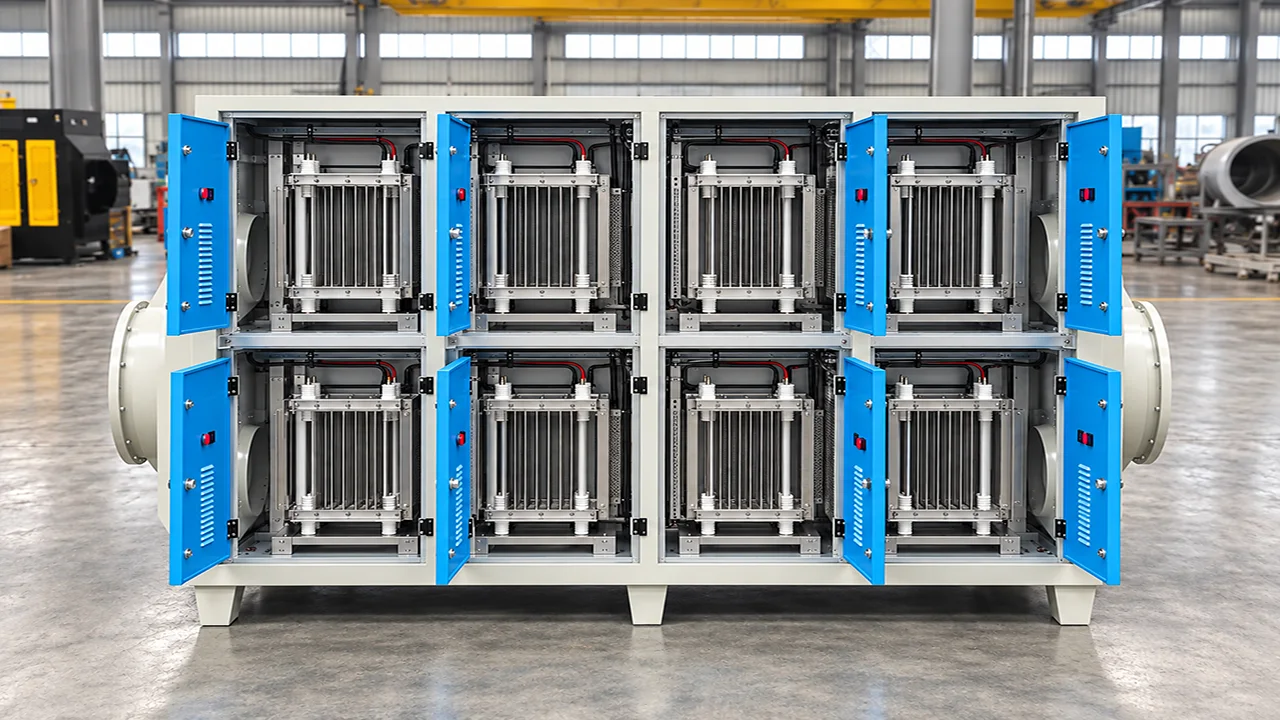
Receives contaminated exhaust and guides it into the internal plasma treatment path.
Form the upper section of the plasma treatment zone, where high-energy plasma acts on gaseous pollutants.
Provides the main internal passage through which the exhaust stream moves across multiple plasma treatment stages.
House the power units that energize the plasma reactor modules and support stable high-voltage operation.
Provide additional treatment positions in the lower section of the purifier cabinet for extended purification contact.
Allow access to reactor modules and internal service areas for inspection, cleaning and maintenance.
Collects the treated airflow after plasma purification and directs it toward the discharge side of the equipment.
Provide the structural enclosure and base support for the full multi-module plasma purification system.
Low-temperature non-equilibrium plasma generates reactive electrons and species for selected gaseous pollutants and odors, without relying primarily on bulk gas incineration.
Source-stated values retained for engineering documentation. Final specifications depend on the selected configuration, feed material and agreed operating conditions. Specification inputs listed on the published page: Airflow and fan duty; Installed power and high-voltage settings; Residence time and module count; Inlet concentration range; Temperature and humidity limits; Ozone or by-product control; Removal efficiency and outlet emissions; Explosion rating, dimensions and service clearances
Selected low- to medium-concentration odor after gas analysis.
After concentration, humidity, flammability and by-product review.
Coating, resin and plastics exhaust when mist and dust are controlled.
Residual gas-phase contaminants after source capture and pretreatment.
No. Plasma transforms selected contaminants through electrical reactions, while activated carbon adsorbs compatible molecules on a porous bed. They may be used together when the process requires polishing.
Significant particulate, oil mist or water droplets should normally be removed upstream. These contaminants can foul or interfere with the plasma module and change the safety assessment.
No. Reaction paths, by-products and outlet performance depend on gas chemistry and operating conditions. Representative testing and a defined compliance method are required.
No universal ozone-control performance is stated. Ozone and other possible by-products must be assessed and controlled according to the actual configuration and local requirements.
Provide gas flow, temperature, humidity, composition, contaminant concentrations, particulate/mist loading, target outlet limits, operating hours, installation country and available layout.
Send material, capacity, target output and site information for an application review.
You can also upload material photos, equipment images, plant layouts or technical documents.
You don't need to know all the technical details. Tell us what you're working with and what you want to achieve, and our team will help you determine the next step.